In previous posts, I have spoken about the importance of robust ITSM processes in driving operational resilience. Effective processes require ownership, documentation, execution, governance, and continual improvement. Today, I want to focus on ownership.
Today I want to focus on one of the most important, and often overlooked, elements of process success: ownership. Whether it is Incident Management, Change Management, Problem Management, Service Continuity Management, or any number of other practices, resilience depends on having processes that are defined, documented, executed, governed, measured, and continually improved.
How does process ownership affect operational resilience in enterprise environments?
In my experience, it has a tremendous impact.
Over the course of my career I have conducted numerous process assessments across organizations of all sizes.
One of the most common findings I encounter is a lack of clear process ownership. When I ask, “Who is the Process Owner?” I often get different answers depending on who I ask.
Sometimes I am told there are multiple owners. Other times people point to a manager, a team lead, or the person who happens to know the most about the process.
The problem is that without clear ownership there is no accountability. Without accountability there is no consistency. And without consistency it becomes very difficult to build operational resilience.
What is a Process Owner?
A Process Owner is accountable for the overall governance, performance, and continual improvement of a process. They establish the policies, objectives, standards, and direction for the process. They ensure the process aligns with business objectives, regulatory requirements, and organizational priorities. Most importantly, they work across organizational boundaries to ensure the process is being adopted and executed consistently throughout the enterprise.
In other words, the Process Owner brings focus.
One question I often hear is whether different teams should have different owners. Should the Network team own Change Management for network changes? Should Infrastructure own it for server changes? Should the Service Desk own it for end-user changes?
My answer is no.
While different teams may execute different procedures within the process, there should be a single accountable process owner at the enterprise level. Someone needs to ensure that standards are being followed, that cross-functional issues are being addressed, and that the process is delivering value to the organization as a whole, not just to one department.
For example, regardless of the team, every change should be registered, assessed, approved, scheduled, reviewed, and closed.
That is the process.
Individual teams may capture different information, follow different approval paths, or apply different levels of scrutiny depending on the service or risk involved. The process remains the same; only the implementation details and procedures vary.
Without overall process ownership, processes tend to evolve independently. One team develops its own version of the process. Another team creates exceptions. Over time the organization ends up with multiple ways of doing the same thing, inconsistent controls, inconsistent reporting, and gaps in accountability. Those gaps eventually become operational risks.
This is particularly important when organizations are trying to improve operational resilience.
Can you imagine if only some departments followed Change Management standards? Or if only certain teams were expected to follow security policies? The resulting inconsistencies would create vulnerabilities that could eventually contribute to service outages, security incidents, compliance failures, or recovery challenges.
Operational resilience depends on consistent operational practices. That consistency starts with ownership.
Of course, ownership does not mean one person performs all the work.
That is where the Process Manager comes in.
What is a Process Manager?
The Process Manager is responsible for the day-to-day management and operation of the process. They maintain documentation, support stakeholders, monitor performance, coordinate improvements, and help ensure the process is consistently applied. Large organizations may have multiple Process Managers supporting different business units, regions, or functional areas. Their role is to execute within the governance framework established by the Process Owner.
How Do Process Owners Work Together?
One of the better models I have seen for coordinating process ownership across the organization is the Service Management Office (SMO).
The Service Management Office brings together Process Owners, Process Managers, Process Analysts, and ITSM Tool Specialists to improve the quality, effectiveness, and efficiency of service management across the enterprise. It provides the governance structure necessary to ensure processes work together and support broader business objectives, including operational resilience.
The SMO is often misunderstood.
Many organizations immediately think about the ITSM tool. In fact, one of the most common frustrations I encounter is organizations focusing on tool configuration before they fully understand their business requirements, process requirements, governance requirements, and desired outcomes.
That approach rarely ends well.
Tools are important. They enable execution, automation, measurement, and reporting. But tools do not create operational resilience. Well-designed, well-governed, and consistently executed processes create operational resilience. The tool simply helps support those processes.
In many ways, this is the same challenge I see organizations facing with digital transformation and AI initiatives. Too much focus on technology and not enough focus on governance, ownership, accountability, and process design.
The technology is important, but it is not the starting point.
If you would like to learn more about the Service Management Office model and how it supports process governance, read our article: What is a Service Management Office? Everything you need to know.
So let’s bring this back to the original question.
How does process ownership affect operational resilience in enterprise environments?
What is the value of Process Ownership?
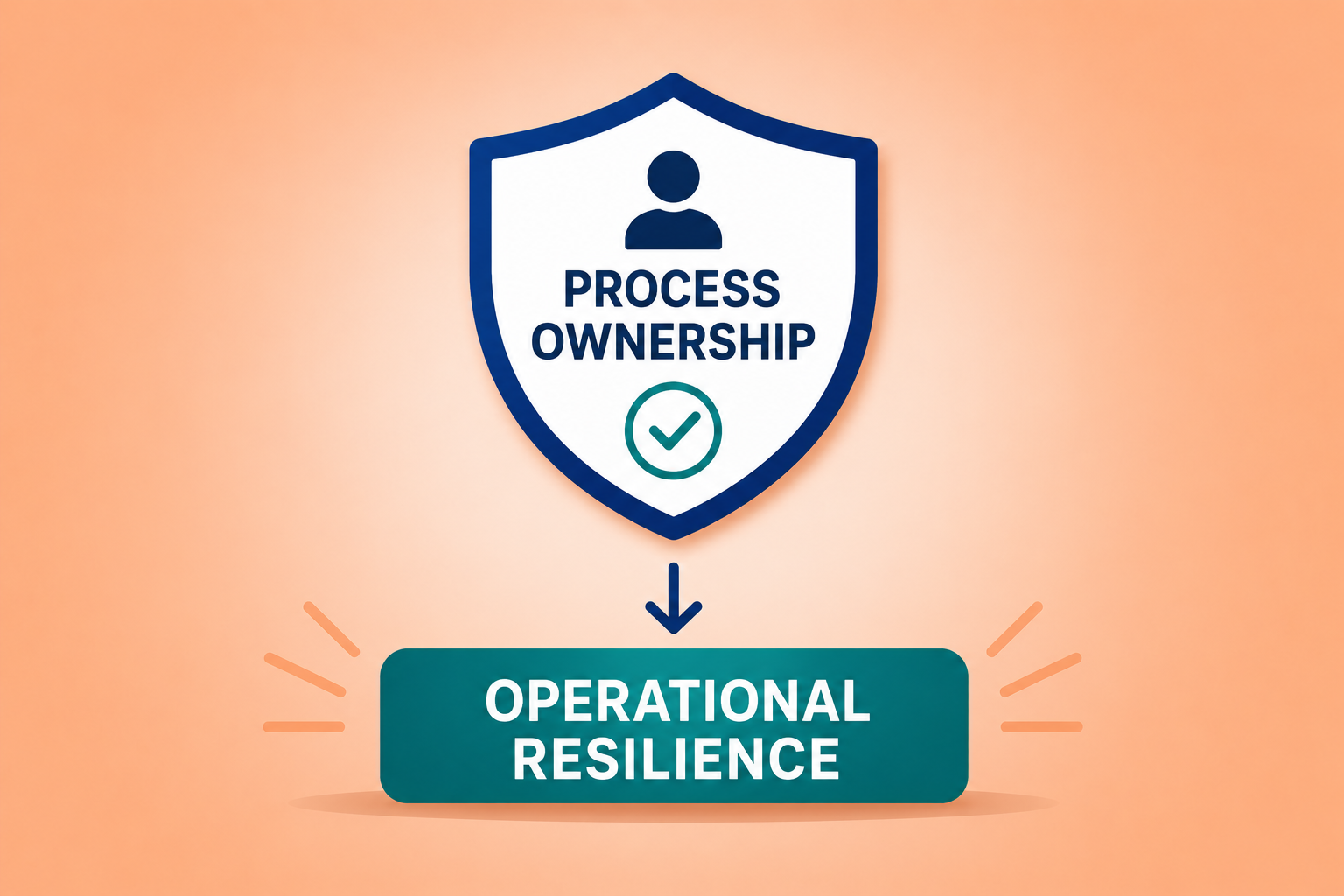
Process ownership creates accountability. Accountability drives consistency. Consistency enables governance, measurement, continual improvement, and cross-functional alignment. Together, these capabilities strengthen the organization’s ability to prevent, withstand, respond to, and recover from disruptions.
In short, resilient organizations have resilient processes, and resilient processes require clear ownership.
If you are trying to strengthen operational resilience, start by understanding the maturity of your processes and the effectiveness of your process ownership model.
How does Process Ownership Drive Operational Resilience?
When major outages, cyber incidents, or operational failures occur, organizations rarely discover they have a technology problem. More often, they discover they have an ownership problem. Decisions were not being made, standards were not being enforced, exceptions were not being challenged, and accountability was unclear.
In my experience, some of the most resilient organizations are not necessarily the ones with the best tools or the largest budgets. They are the ones where people know who owns the process, who is accountable for its outcomes, and who is responsible for ensuring it continually improves.
Learn More
At Navvia, we help organizations assess, design, implement, and improve ITSM processes that support operational resilience. Our assessments evaluate not only whether a process is documented, but whether it is actually being adopted, executed, governed, measured, and continually improved. Our process design tool, with built in templates, helps you design and document your processes.

Process ownership may not be the most visible component of operational resilience, but it is often the foundation upon which everything else depends.