Why faster technology demands adaptive governance, not just more guardrails.
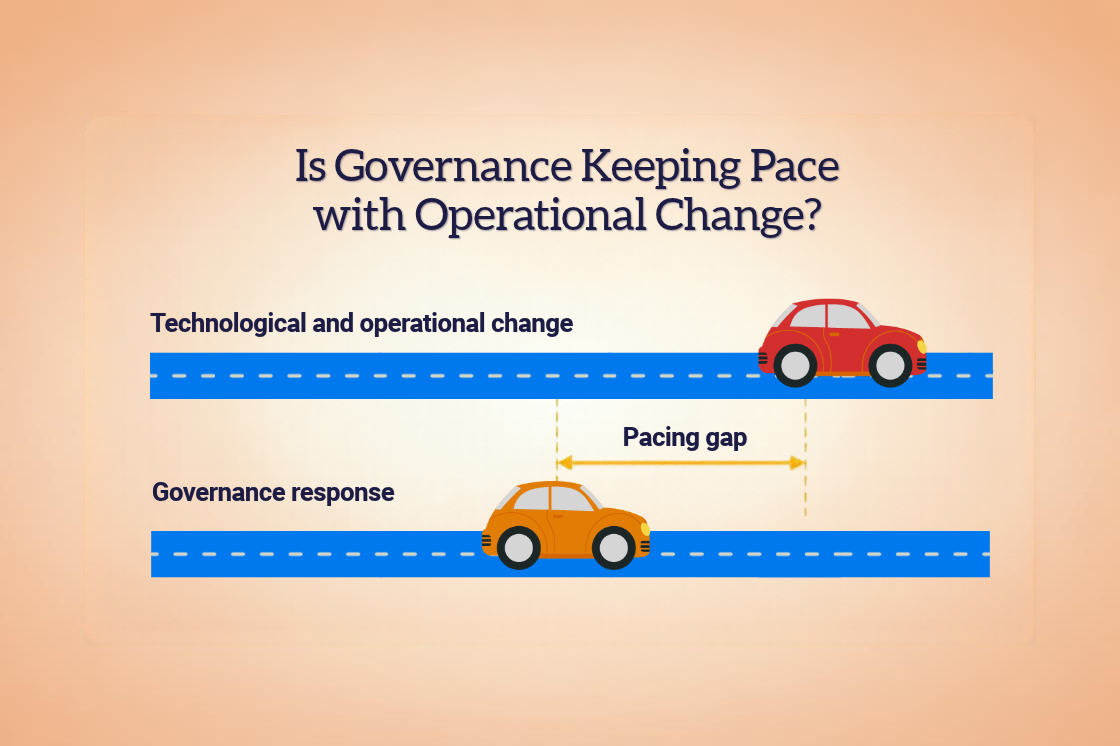
The short answer is no, but the real answer is more nuanced.
Governance frameworks and activities have always lagged behind change to some degree. Laws evolve, operating models shift, new risks emerge, and unexpected events occur. Organizations have always had to adjust their governance in response.
What is different now is the pace.
Technological innovation continues to accelerate. This is most obvious with AI, but similar changes are occurring across other technological, operational, regulatory, and societal domains.
Change is happening faster than many of the governance mechanisms responsible for managing it.
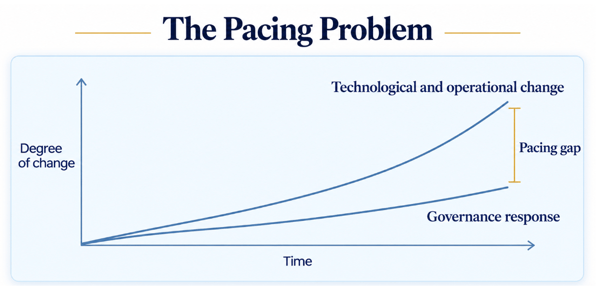 The pacing gap between technological and operational change and the governance response. Adapted from the “pacing problem” described by Marchant et al. (2011).
This challenge is often described as the pacing problem: technology and operating practices advance faster than the laws, regulations, policies, and governance mechanisms intended to oversee them.
Some degree of lag is inevitable. Governance cannot anticipate every innovation, regulatory change, or operational surprise.
The more important question is whether organizations can recognize meaningful change and respond before the gap becomes unacceptable.
Closing that gap does not mean making governance move as quickly as technology. Nor does it mean introducing more policies, committees, and approval steps. More governance activity does not necessarily produce better governance. In fact, it may make the organization slower without making it safer.
Organizations must instead connect governance, compliance, and operations through shared accountability, integrated processes, timely information, and adaptable decision and control mechanisms.
Before considering how to do that, we need to be clear about what governance means—and what it does not.
What Do We Mean by Governance?
Governance becomes operational through three connected elements:
- Governance frameworks define what is expected.
- Governance activities determine how those expectations are put into practice.
- Guardrails help keep decisions and actions within approved boundaries.
Together, they provide the structure, work, and controls required to direct the organization, manage risk, and maintain accountability.
Let’s look at each in more detail.
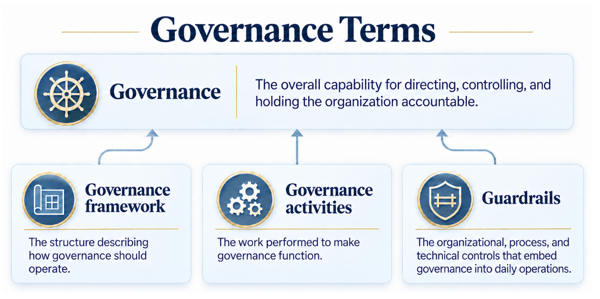 Governance becomes operational through a framework that defines how it should work, activities that put it into practice, and guardrails that embed it in daily operations.
Defining Governance
Governance is the system through which an organization directs its activities, makes decisions, assigns accountability, manages risk, and oversees performance.
It helps ensure that the organization acts responsibly and meets its strategic, operational, regulatory, financial, ethical, and fiduciary obligations.
In practical terms, governance determines:
- Who has the authority to make decisions.
- Who is accountable for the outcomes.
- What rules and expectations apply.
- How performance and risk are monitored.
- What happens when results fall outside acceptable boundaries.
Governance is broader than compliance. Compliance focuses on meeting specific obligations. Governance ensures that the organization is directed, controlled, and held accountable.
What Is a Governance Framework?
A governance framework is the organized structure used to establish, operate, and maintain governance.
Examples of frameworks and standards that support governance include the NIST Cybersecurity Framework for cybersecurity risk, COSO ERM for enterprise risk management, ISO/IEC 42001 for AI management systems, and the HITRUST CSF for information security and privacy in healthcare.
A governance framework normally defines:
- Principles and objectives.
- Roles and responsibilities.
- Decision rights and approval authorities.
- Policies, standards, and procedures.
- Risk and control requirements.
- Reporting and escalation mechanisms.
- Performance measures.
- Oversight and review arrangements.
A framework describes how governance is intended to work. It does not govern anything by itself. Governance becomes real only when the framework is translated into operational processes and consistently applied.
What Are Governance Activities?
Governance activities are the recurring actions and processes used to provide direction, oversee performance, manage risk, and ensure compliance.
They include:
- Setting direction and priorities.
- Assigning decision rights, ownership, and accountability.
- Establishing and overseeing policies, processes, standards, and controls.
- Identifying compliance obligations and assessing risks.
- Making decisions and managing exceptions.
- Monitoring performance, risk, controls, and compliance.
- Managing non-compliance, escalation, and reporting.
- Maintaining evidence, correcting deficiencies, and driving continual improvement.
These activities translate the governance framework into decisions, oversight, and action.
They shape how processes operate, ensure that guardrails are applied, and provide the monitoring, evidence, and corrective action needed to manage risk, maintain accountability, and demonstrate compliance.
What Are Guardrails?
Guardrails are the organizational, process, and technical controls embedded in daily operations to keep decisions and actions within approved boundaries.
They translate governance requirements into practical limits that protect the organization while allowing work to proceed.
Guardrails can include:
- Policies, standards, and acceptable-use requirements.
- Roles, permissions, and access restrictions.
- Approval thresholds and human-review requirements.
- Data-handling, testing, and documentation requirements.
- Automated controls, monitoring, alerts, and escalation triggers.
For AI, guardrails can restrict the data, tools, and systems a solution may access, the content it may generate, and the actions it may take.
They are particularly important for agentic AI. An AI agent may plan tasks, use tools, interact with systems, and act with limited human involvement. Guardrails can require approval for sensitive or irreversible actions, impose financial and operational limits, monitor unexpected behaviour, and pause activity when established boundaries are exceeded.
Effective guardrails do not eliminate autonomy. They make responsible autonomy possible by allowing people and AI systems to operate efficiently within clearly defined limits.
Governance Is a People, Process, and Technology System
It is tempting to think about governance primarily in terms of policies, committees, and controls.
In practice, effective governance depends on the alignment of people, processes, and technology.
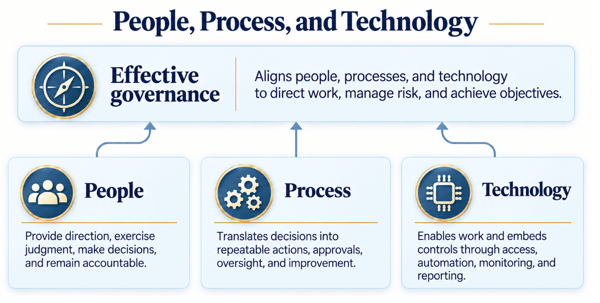 Effective governance aligns people who provide judgment and accountability, processes that translate decisions into action, and technology that enables and controls execution.
People establish direction, exercise judgment, make decisions, and remain accountable for outcomes.
Processes are where work gets done. They translate decisions into repeatable actions and determine when review, approval, escalation, or intervention is required.
Technology enables the work and increasingly embeds governance directly into operations through permissions, automated controls, monitoring, evidence collection, and reporting.
Weakness in any one of these areas creates a governance gap.
Clear policies are ineffective when operational processes do not apply them. Well-designed processes fail when accountability is unclear. Technical controls can enforce rules, but they cannot determine whether those rules reflect the organization’s objectives, values, and risk appetite.
Effective governance requires all three.
Governance Is More Than Guardrails
Governance and guardrails are related, but they are not interchangeable.
Governance determines what should be allowed, why it should be allowed, who has authority, and who is accountable.
Guardrails translate selected governance decisions into operational boundaries. They can prevent an action, require approval, detect unexpected behaviour, or trigger escalation.
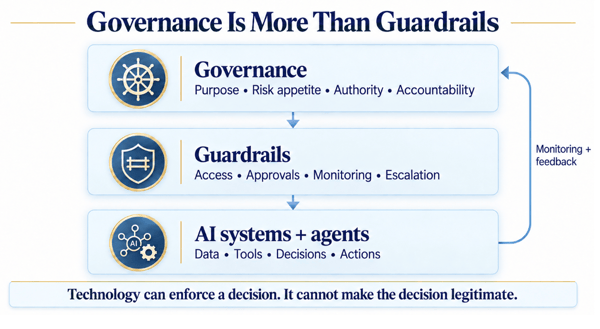 Effective AI oversight requires both human authority and technical enforcement, connected by continuous monitoring and feedback.
With AI, there is a risk that organizations will equate governance with a technical control plane or a collection of automated guardrails.
These technologies are valuable, particularly for agentic AI. They can manage access, enforce policies, restrict data use, monitor behaviour, maintain evidence, and stop an agent that exceeds its authority.
But a technical layer is not governance by itself.
It cannot establish the organization’s risk appetite, resolve competing business and ethical priorities, assign meaningful accountability, or determine whether a particular use of AI is appropriate.
Technology can enforce a decision. It cannot make that decision legitimate.
AI governance should therefore extend—not replace—existing governance. Traditional governance remains necessary, but its processes and pace must adapt to the speed and autonomy of AI.
Closing the Pacing Gap
The answer is not simply to create more policies, committees, or approval steps. That approach may increase control, but it can also make governance slower and create unnecessary friction.
Governance must become more adaptive across people, processes, and technology.
Organizations should:
- Give people clear accountability, decision authority, and the skills needed to govern AI.
- Integrate governance activities into the processes through which AI is selected, developed, purchased, deployed, and monitored.
- Apply different levels of review based on the risk and potential impact of each use case.
- Use technical guardrails to automate routine controls and evidence collection.
- Monitor AI systems continuously rather than relying only on periodic reviews.
- Trigger reassessment when models, data, regulations, operating conditions, or intended uses change.
- Maintain clear exception, escalation, intervention, and shutdown mechanisms.
- Measure whether governance itself is timely, effective, and creating unnecessary friction.
The objective is not to make governance react to every technological development.
It is to make governance responsive enough to recognize meaningful change, reconsider its decisions and guardrails, and intervene before the organization moves beyond acceptable boundaries.
So, is governance keeping pace with operational change?
In many organizations, the answer is still no. But the problem is not that governance has become unnecessary. It is that governance must become more adaptive, more deeply embedded in operational processes, and better supported by technology.
AI governance platforms and guardrails will be important parts of that evolution, especially as agentic AI gains greater autonomy. But they cannot replace the people, judgment, accountability, and processes that make governance legitimate and effective.
Operational change, much of it driven by AI, is accelerating. Governance must become adaptive enough to keep pace.