Artificial intelligence is being adopted faster than most organizations can govern it. Employees are using ChatGPT. Development teams are embedding AI into applications. Vendors are adding AI capabilities to products already in production. Business units are experimenting with AI-powered decision making.
In many organizations, AI is already influencing business outcomes whether leadership realizes it or not.
The conversation is often focused on technology. What types of AI to implement? Which models should we use? Should we build or buy? How accurate is the output?
Those are important questions. But they are not the first questions organizations should be asking.
The first question is much simpler:
Can we demonstrate that AI is being governed appropriately?
That is where AI compliance begins.
AI Compliance Is Not a Technology Problem
When most people think about AI compliance, they think about model testing, bias detection, explainability, or algorithm reviews.
Those are certainly important.
But most compliance failures occur long before anyone examines the model itself.
They happen because organizations cannot answer basic governance questions:
- Who owns the AI solution?
- What business problem is it solving?
- What data is being used?
- What controls exist around its use?
- Is there an acceptable use policy?
- How are risks assessed?
- Who approves deployment?
- How are incidents reported and investigated?
- How is ongoing performance monitored?
- What happens when outputs are inaccurate or harmful?
These are governance and process questions.
And governance failures create operational risk.
The Regulatory Landscape Is Expanding
Organizations are facing growing pressure to demonstrate responsible AI governance.
Frameworks and regulations such as:
- NIST AI Risk Management Framework (AI RMF)
- ISO/IEC 42001
- EU AI Act
- Emerging Canadian AI legislation
- Industry-specific regulatory requirements
all emphasize accountability, risk management, transparency, documentation, oversight, and continuous monitoring.
What’s interesting is that these frameworks are remarkably consistent.
They all focus on understanding risk, assigning accountability, documenting controls, monitoring outcomes, and demonstrating ongoing governance.
In other words, they focus on operational discipline.
Operational Resilience Depends on AI Governance
Operational resilience is the ability to prevent, withstand, respond to, and recover from disruption.
As AI becomes embedded in business operations, it becomes another source of operational dependency.
If an AI system:
- produces inaccurate recommendations
- exposes sensitive information
- introduces bias into decisions
- generates misleading content
- fails unexpectedly
- creates regulatory violations
the organization still owns the consequences.
The technology may be new.
The operational risk is not.
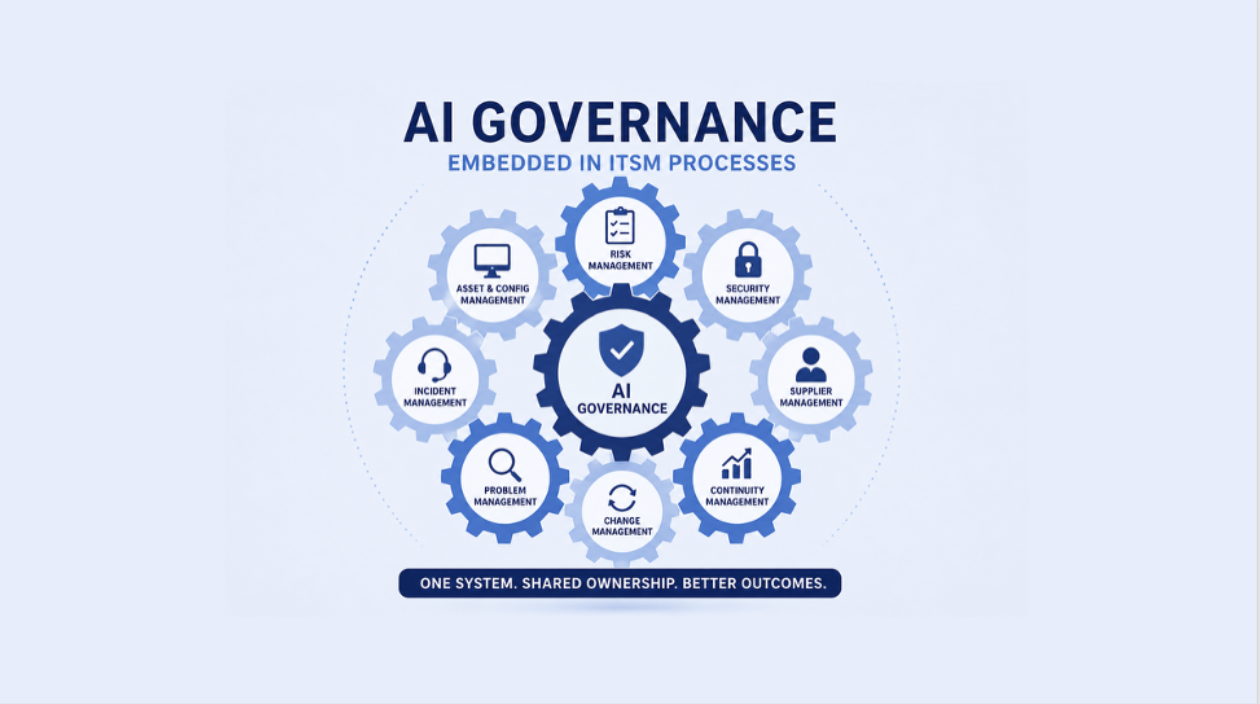
Just as organizations assess risks associated with incident management, change management, cybersecurity, vendors, and continuity planning, they must assess the governance surrounding AI adoption. Read more at Why AI Multiplies Cyber Security Risks
What Should an AI Compliance Assessment Evaluate?
An effective AI compliance assessment should examine far more than technology.
It should assess whether the organization has established appropriate governance, processes, and controls across key areas such as:
Governance and Accountability
- Defined ownership
- Executive oversight
- Decision-making authority
- Policy management
- Accountability structures
These governance concepts are not unique to AI. Organizations have long relied on process governance models to establish accountability and maintain control. Read: Process Governance Model Maintains the Integrity of Process
Risk Management
- AI risk identification
- Risk assessment methodology
- Mitigation planning
- Risk monitoring
- Escalation procedures
Data Management
- Data quality
- Data ownership
- Privacy controls
- Data retention
- Third-party data usage
Operational Controls
- Change management
- Access management
- Incident management
- Vendor oversight
- Monitoring and reporting
Many resilience failures ultimately trace back to weak operational processes rather than technology alone. Read: Operational Resilience Issues? It’s Likely Weak ITSM Processes
Compliance and Documentation
- Regulatory alignment
- Audit readiness
- Evidence management
- Control documentation
- Traceability and record keeping
These are the same foundational capabilities that support broader operational resilience programs. The difference is that AI introduces new risks that must be incorporated into existing governance structures. ISACA’s guidance on auditing AI reaches a similar conclusion: assurance should focus heavily on governance, controls, accountability, risk management, and business process controls rather than simply examining algorithms.
The Challenge Most Organizations Face
The biggest challenge is not compliance.
It is visibility.
Many organizations cannot confidently answer:
- Where is AI being used?
- Which vendors include AI capabilities?
- Which business processes depend on AI?
- What controls exist today?
- What risks remain unaddressed?
Without visibility, governance becomes reactive.
Without governance, compliance becomes difficult.
Without compliance, operational resilience is weakened.
A Practical Assessment Approach
At Navvia, we believe organizations should start with an assessment rather than a tool.
Before implementing governance platforms, documenting controls, or pursuing certifications, organizations need a clear understanding of their current state.
Assessment provides the visibility needed to understand governance maturity, operational risk exposure, and readiness for broader AI adoption.
That means engaging stakeholders, evaluating existing processes, reviewing governance structures, identifying risks, and measuring maturity against recognized frameworks.
The goal is not simply to determine whether AI is compliant today.
The goal is to understand whether the organization can continue adopting AI safely, responsibly, and consistently as usage expands. Learn more at: Introducing Navvia’s AI-Powered Operational Resilience Report
Because AI compliance is not a one-time exercise. t is an operational capability.
And like every operational capability, it depends on governance, process, accountability, and execution.
AI compliance isn’t a one-time exercise. It’s an ongoing operational capability that depends on governance, process ownership, accountability, and execution.