Every week there seems to be a new AI announcement. A new model. A new agent. A new startup promising to replace half your workforce by Friday. Here is a short primer on the different types of AI systems and how they can be used.
As someone who has spent most of my career in process management, governance, assessments, and operational resilience, I find myself both excited and slightly concerned.
Not because AI isn’t impressive. It absolutely is.
But because many organizations are jumping into AI discussions without first understanding what type of AI they’re talking about, where it should be used, and what controls should be in place, such as an acceptable use policy, before it is trusted with business-critical decisions.
If there’s one lesson process professionals learn early, it’s this:
Not every activity requires full autonomy.
Sometimes a checklist is better than improvisation.
Sometimes a workflow is better than a genius.
And sometimes a human should still be involved.
Before organizations rush toward “AI transformation,” it helps to understand the different forms AI is taking today.
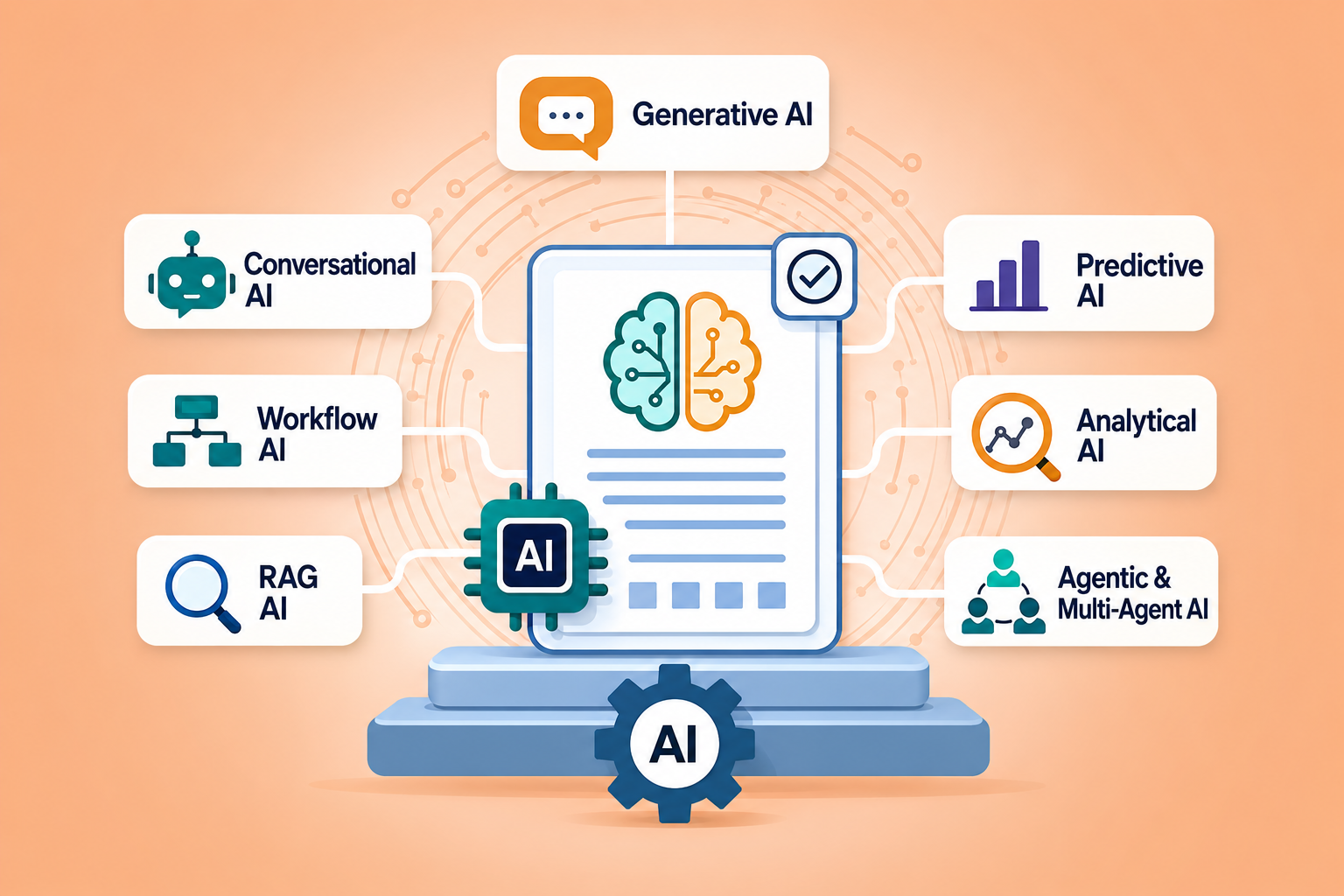
Generative AI: The Content Creator
This is the AI most people know.
Give it a prompt and it creates something new:
- Text
- Images
- Code
- Presentations
- Videos
Tools like ChatGPT fall into this category.
Generative AI is incredibly useful for:
- Drafting documents
- Summarizing information
- Brainstorming ideas
- Translating content
- Accelerating routine knowledge work
The key thing to remember is that generative AI creates content.
It does not automatically execute business processes, make operational decisions, or complete work.
Despite what some LinkedIn posts might suggest, asking ChatGPT to “run the company” is still not considered a best practice.
Conversational AI: The Communicator
Conversational AI focuses on interaction.
Chatbots, virtual assistants, and AI-powered support agents all fit into this category.
Their strength is helping people access information quickly through natural language conversations.
The limitation is that most conversational systems remain reactive. They wait for instructions. They answer questions.
They don’t typically take action unless connected to additional systems and workflows.
Workflow AI: The Process Professional’s Friend
This is where things start becoming particularly interesting for enterprises.
Workflow AI operates inside a defined process.
For example:
- An incident is submitted
- AI categorizes it
- AI proposes a priority
- AI routes it to the appropriate team
- A human reviews and approves
Unlike more autonomous approaches, workflow AI operates within established rules, controls, and governance structures.
It follows a designed path.
It is generally:
- More predictable
- Easier to audit
- Easier to explain
- Easier to govern
Which is exactly why many organizations will likely gain more value from workflow AI than from fully autonomous agents in the near term.
As process practitioners, we’ve spent years creating controls for a reason. Removing all of them because an AI appears confident is rarely a sound governance strategy.
Organizations considering workflow AI should ensure their operational processes are mature enough to support automation. Check our article Immature ITSM? AI Will Make It Dangerous!
Retrieval-Augmented Generation (RAG): AI That Reads Before It Speaks
One of the biggest challenges with AI is trust.
AI models can generate impressive answers.
They can also generate answers that sound impressive while being completely wrong.
That’s where Retrieval-Augmented Generation, or RAG, enters the picture.
Rather than relying solely on training data, RAG systems:
- Search trusted sources
- Retrieve relevant information
- Use that information to generate responses
Think of it as the difference between:
“I think the policy says…” and “I just read the policy and here’s what it says.”
For organizations managing procedures, standards, assessments, and knowledge repositories, RAG is quickly becoming a foundational architecture.
The better the source material, the better the answer.
Which brings us to another uncomfortable reality:
If your documentation is outdated, inconsistent, or incomplete, AI will help you discover that very quickly.
Predictive AI: Looking Forward
Predictive AI focuses on forecasting outcomes.
Examples include:
- Fraud detection
- Demand forecasting
- Predictive maintenance
- Customer churn prediction
- Risk scoring
Unlike many generative AI solutions, predictive systems are often built using machine learning models trained on historical patterns.
Their job isn’t to create content.
Their job is to identify what might happen next.
For operational resilience professionals, this is particularly valuable.
Predicting potential issues before they become incidents is far less expensive than managing the incident afterward.
Analytical AI: Finding What Humans Miss
Analytical AI examines data to identify:
- Trends
- Correlations
- Bottlenecks
- Anomalies
- Root causes
Imagine reviewing thousands of incidents, changes, risks, and service requests simultaneously.
Humans can do it. Eventually.
Analytical AI can often identify patterns much faster.
The important distinction is that analytical AI identifies insights. It doesn’t necessarily decide what should happen next.
Decision Intelligence: Recommendations With Context
Decision Intelligence builds on analytics and prediction.
Rather than simply presenting information, it recommends actions.
For example:
“Customer churn risk has increased by 22%. Consider prioritizing outreach to these accounts.”
These systems combine:
- Analytics
- Predictive models
- Business rules
- Organizational objectives
The recommendation may be intelligent.
But governance still matters.
Organizations must determine:
- Who owns the decision?
- When is human approval required?
- What level of confidence is acceptable?
- How are recommendations validated?
Those questions sound remarkably similar to the governance discussions we’ve been having around change management for decades.
Because they are.
Agentic AI: The Current Star of the Show
Agentic AI is receiving enormous attention right now.
Unlike traditional AI systems, agents pursue goals rather than individual instructions.
Instead of saying:
“Write an email.” You might say: “Launch our partner program.”
The agent could:
- Gather requirements
- Research competitors
- Draft communications
- Create project plans
- Revise materials
- Coordinate activities
All with limited supervision.
Impressive? Absolutely.
Risk-free? Absolutely not.
From a governance perspective, agentic AI introduces important questions:
- What decisions can it make?
- What systems can it access?
- What actions require approval?
- How are activities monitored?
- Who is accountable for outcomes?
The process person in me immediately starts looking for approval workflows, audit logs, segregation of duties, and exception handling.
Not because I dislike innovation.
Because every operational failure I’ve ever assessed eventually traced back to unclear accountability, inconsistent execution, or insufficient controls.
As AI systems gain access to business data, applications, and operational processes, they can also introduce new cybersecurity and operational risks that organizations must actively manage. Read: Why AI Multiplies Cyber Security Risks
AI doesn’t eliminate those risks. In some cases, it amplifies them.
Multi-Agent Systems: When AI Forms a Team
The next evolution involves multiple specialized agents working together.
Imagine:
- A research agent gathers information
- A compliance agent reviews regulations
- A finance agent estimates costs
- A planning agent develops recommendations
Each agent specializes in a specific area while collaborating toward a larger objective.
This model is becoming increasingly common in enterprise architectures because specialization often produces better results than asking a single AI to do everything.
Interestingly, this starts looking a lot like how organizations already operate.
Different roles. Different expertise. Shared objectives.
The difference is that some of the team members happen to be software.
The Enterprise AI Maturity Journey
Most organizations are likely to progress through AI adoption in stages:
Stage 1: Generative AI
- Content creation
- Summaries
- Chat interfaces
Stage 2: RAG AI
- Grounded in trusted organizational knowledge
Stage 3: Workflow AI
- Embedded within business processes
Stage 4: Agentic AI
- Goal-oriented execution
Stage 5: Multi-Agent Systems
- Coordinated AI teams operating across functions
Not every organization needs to reach Stage 5 immediately.
In fact, many organizations haven’t fully documented the processes that Stage 3 would automate.
Which leads to an important observation.
You cannot automate a process you do not understand.
Well, technically you can.
But you’ll simply automate confusion faster.
What This Means for Process Management
The organizations that succeed with AI won’t necessarily be the ones that buy the most AI tools.
They will be the ones that understand:
- Their processes
- Their governance model
- Their decision rights
- Their risk tolerances
- Their operational objectives
AI performs best when operating within a well-understood environment.
Clear processes produce better automation.
Clear governance produces safer automation.
Clear accountability produces sustainable automation.
None of that changes because the technology becomes more sophisticated.
As organizations embrace Ai they should understand their current process maturity, governance capabilities, and operational readiness before accelerating AI adoption.
Where We See the Future
From a Navvia perspective, the progression feels relatively natural.
First, AI helps users access process guidance, assessment results, evidence, and reports through RAG-based capabilities.
Then generative AI helps create:
- Findings
- Recommendations
- Executive summaries
- Process documentation
Next comes analytical AI that identifies patterns across assessments, processes, controls, and operational risks.
Beyond that, agentic capabilities can help assess processes, identify gaps, recommend improvements, and guide remediation activities.
Eventually, specialized agents may collaborate across process management, operational resilience, compliance mapping, and assessment execution.
The destination isn’t simply more automation. The destination is improved organizational effectiveness and resilience.
And if history has taught process professionals anything, it’s this:
Technology alone rarely solves operational problems.
Good processes, clear governance, accountable ownership, and disciplined execution still matter.
AI just gives us a much more powerful way to put those principles into practice.
What type of AI is your organization experimenting with today? Generative AI? Workflow automation? Agentic systems? Or are you still trying to figure out where AI fits into your operating model?